
All You Can Books

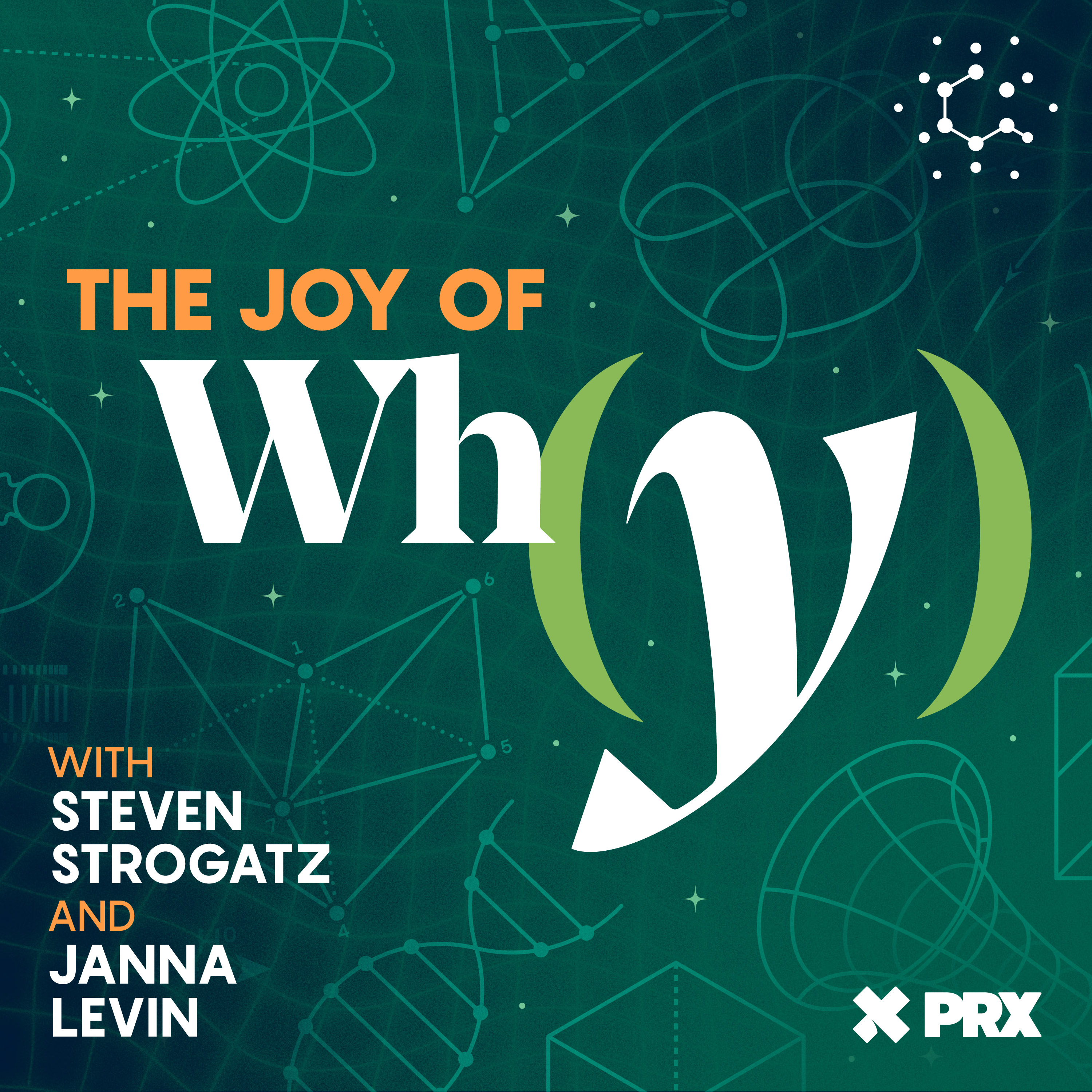
The Joy of Why

Steven Strogatz, Janna Levin and Quanta Magazine

The Joy of Why

The Joy of Why

“The Joy of Why” is a Quanta Magazine podcast about curiosity and the pursuit of knowledge. The mathematician and author Steven Strogatz and the cosmologist and author Janna Levin take turns interviewing leading researchers about the great scientific and mathematical questions of our time. New episodes are released every other Wednesday. Quanta Magazine is a Pulitzer Prize–winning, editorially independent online publication launched and supported by the Simons Foundation to illuminate big ideas in science and math through public service journalism. Quanta’s reporters and editors focus on developments in mathematics, theoretical physics, theoretical computer science and the basic life sciences, emphasizing timely, accurate, in-depth and well-crafted articles for its broad discerning audience. In 2023, Steven Strogatz received a National Academies Eric and Wendy Schmidt Award for Excellence in Science Communications partly for his work on “The Joy of Why.”

Podcast Episodes

Can Network Science Transform Health and Nutrition?
November 12, 2026

Nothing really exists in isolation. Almost every part of our lives exists in a network. Consciousness arises from what neurons do together, life from what genes and proteins do together, society from what we do together. When researchers began mapping real-world networks in the 1990s – from the World Wide Web to Hollywood actors linked by films – they found that wildly different systems shared architectural features that their components alone could not explain. This suggested common organizing principles for how networks form and develop.

In this episode, two of the pioneers of network science – Albert-László Barabási and co-host Steven Strogatz – discuss how the field took shape, the ideas that underpin it, and why this is more than graph theory under a different name. The conversation then turns to health and nutrition. Disease-related genes cluster in “network neighborhoods”, Barabási explains, which may help identify better drug targets and predict which patients will respond to which drugs. That work led him to his Foodome project, which catalogs the molecules found in the food we eat and asks what they do inside our cells. By his count, around 135,000 compounds lie outside conventional nutrition, which concerns itself mainly with energy, building blocks, and vitamins. These compounds, which he calls the “dark matter of nutrition,” and their effects on the body are only beginning to be understood.

Download This Episode

How Do You Take a Picture of a Black Hole?
October 29, 2026

Black holes are one of the universe’s most exotic and elusive objects. When nothing, not even light, can escape their powerful gravitational grasp, taking a picture of one seems unimaginable. But an image of a black hole, or more accurately its shadow, could offer insights that theory alone may not provide when testing predictions. So how can it be done? 

Harvard astrophysicist Shep Doeleman and a team of 250 researchers achieved this extraordinary feat by linking a group of radio telescopes around the world. This network, called the Event Horizon Telescope, produced the first image of a supermassive black hole in the galaxy M87, around 55 million light-years away, and the first image of the black hole at the heart of our galaxy. In this episode, Doeleman tells co-host Janna Levin how he turned the Earth into a telescope capable of seeing a black hole, the incredible level of science and collaboration that was required to achieve this, how the images have furthered our understanding of these exotic objects, and how movies of black holes may be possible by the early 2030s. 

Download This Episode

How Do Fungi Keep the Planet Healthy?
October 15, 2026

People may think of soil as just dirt, but it is anything but inert. Beneath your feet, a vast network of mycorrhizal fungi is hard at work, trading minerals with plant roots. This trading system helps enrich the soil, and it sequesters 13 billion tons of atmospheric carbon dioxide each year — roughly equivalent to one-third of the world’s fossil-fuel emissions. Scientists know that these fungi form partnerships with 80% of all plant species on Earth, a relationship that evolved some 450 million years ago. What they have not understood is how organisms with no brain or central nervous system can decide whom to trade with, and on what terms.

Toby Kiers, an evolutionary biologist at Vrije Universiteit Amsterdam, has spent much of her career making this hidden world visible. Drawing on economics and game theory, and using tools that range from fluorescent quantum dots to imaging robots, her lab is probing how fungi and plants conduct their trade. The work raises new questions about soil, carbon, and even what counts as an individual organism. In this episode, Kiers tells co-host Steven Strogatz how these brainless, decentralized organisms can behave strategically — discriminating between better and worse partners and shifting resources across the network to wherever a plant will “pay” more for it — and how she has built a worldwide community of researchers 

Download This Episode

What Does the Fourth Dimension Actually Look Like?
October 01, 2026

We know all about how things exist in the three dimensions of length, width, and height. Physicists often talk about time as a fourth dimension, but what if there were a fourth spatial dimension — another direction entirely? How on earth would we picture that?

Mathematicians use topology to visualize abstract spaces in higher dimensions. Maggie Miller at the University of Texas at Austin explores what happens when knots encounter an extra dimension. Familiar tangled loops behave in unexpectedly complex and counterintuitive ways in 4D: Knots can always come undone, while ordinary surfaces like spheres can — surprisingly — become knotted in ways that can’t be undone.

In this episode, Miller explains to co-host Janna Levin why 4D is the lowest dimension that mathematicians still don’t fully understand, how she and her collaborators resolved a question about knotted surfaces first posed by mathematician Charles Livingston in 1982, and how her interest in art has helped her develop the visual techniques she uses to picture 4D spaces. 

Download This Episode

How It Works

30-day FREE trial

Get ALL YOU CAN BOOKS absolutely FREE for 30 days. Download our FREE app and enjoy unlimited downloads of our entire library with no restrictions.

UNLIMITED access

Have immediate access and unlimited downloads to over 200,000 books, courses, podcasts, and more with no restrictions.

Forever Downloads

Everything you download during your trial is yours to keep and enjoy for free, even if you cancel during the trial. Cancel Anytime. No risk. No obligations.

Significant Savings

For just $24.99 per month, you can continue to have unlimited access to our entire library. To put that into perspective, most other services charge the same amount for just one book!

Start Your Free Trial Now

Our Story

Welcome to All You Can Books, the ultimate destination for book lovers.

Welcome to All You Can Books, the ultimate destination for book lovers.

As avid readers, we understand the joy of immersing ourselves in a captivating story or getting lost in the pages of a good book. That's why we founded All You Can Books back in 2010, to create a platform where people can access an extensive library of quality content and discover new favorites.

Since our founding days, we’ve continuously added to our vast library and currently have over 200,000 titles, including ebooks, audiobooks, language learning courses, podcasts, bestseller summaries, travel books, and more! Our goal at All You Can Books is to ensure we have something for everyone.

Join our community of book lovers and explore the world of literature and beyond!